Wednesday, October 20, 2021

Chinon CS and CX II Cameras - Welcome to the 70s

The Chinon CS and CX II cameras are both made in the 70s and uses M42 lens mount.  They are mechanical cameras with shutter speeds from 1/1000s to 1s and B.  They do use batteries, but only to power the meters.  The CS and CX II only differ in the way they operate the light meter.  In both cases, they meter stopped down using match needle in the viewfinder.  The CS uses a stop down switch on the right side of the lens, where as the CX II stops down and meter when the shutter button is half pressed.  Under the skin they are almost the same.  The meter on my CS does not function and I use it using sunny 16 rule or with an external light meter.  However, my CX II's meter actually work.    Since the camera was designed for mercury 1.35V battery, I set the film speed 1 stop over to compensate for the different battery voltages.  As a side note, these cameras were sold under different names in different countries.  In the UK, they were also sold a Prinzflex by Dixon chain of shops.

Chinon CS with Helios 58mm F2 lens.  Note the stop down metering switch on the left of the lens.


Chinon CX II with Fujinon 55mm F1.8 lens.  Metering is performed when the shutter button is half pressed.


In term of focus aid, they have micro prisms on the ground glass but no split focus screen.  It would be good to have both.  With bright lenses, I find the screen to be bright and easy enough to see through for most conditions.  In dark environments, the match needle can be hard to see.  But then the Cds light cells are not that sensitive in low light anyway.  Both cameras have hot shoes and also flash sync sockets for FP and X sync flashes.


Both cameras are quite old now.  Even though they are working well, I did remove the bottom plates and lubricated all the moving parts with light bicycle chain oil.  They were notably smoother after.  All the light seals and mirror bumper have disintegrated.  I bought new light seals from eBay and cleaned and replace the seals.  Both cameras are light tight now.  Hopefully, they will work for another 40 years.


One thing to note is these cameras are heavy!  Construction is solid and almost everything are made of metal.  Shutters are also quite loud.  They are not stealth cameras.  These cameras have vertical travel metal shutter with a flash sync speed of 1/125s, which is double of the horizontal travel cloth shutter can achieve.  Due to the higher flash sync speed, they have become my studio camera of choice, especially the CS, as the meter does not work.


Would I recommend these cameras?  That is a definite yes!  They are cheap, reliable and easy to use.  They are readily available on eBay, so I would not pay over the top price for them.  Even if the meter is not working, they are great cameras to shoot with with a light meter app or using sunny 16 rule.  If you use them in the studio, you will have a flash meter anyway.  Here are a few more photos from the last shoot using the CS with Fujinon lens shot with Kentmere 100 film


Thursday, October 7, 2021

Fujica AZ-1, A Very Enjoyable Easy To Use Camera From The 70's

I started to shoot a lot of film recently.  Due to the lock down in the UK in 2020, I had a lot more time than normal.  The AZ-1 was purchased together with another camera and lenses for a low cost.  At first I didn't think I will use it.  However, after it was cleaned up I found it is a very useful walk around camera.  It offers open aperture metering with Fujinon M42 lenses.  They have a small tab that allows the camera to know the aperture setting.  LEDs inside the view finder shows the shutter speed the camera has chosen.  This is quite innovative in the 1970's.  What I do know is this was the last M42 camera Fuji made before switching to AX mount.  It was also the first camera to be sold with a zoom lens, a 43-75mm F3.5/4/5 lens.  The photos below shows the camera with this lens.  Cosmetically my camera is not great but it is fully functional.  I did have to replace all the light seals and mirror bumper.  The old seals and foam were disintegrating.  I also took the time to remove the bottom plate to lubricate all the moving part with light oil.  There was a thick coating of dust on the ground glass and mirror which I cleaned with lens cleaner.


The 35-75mm lens did not receive good reviews when it was released.  I have not shot with it yet.  All the photos on this review were shot with the Fujinon 55mm f2.2 lens.

The controls of the camera is simple, it is an aperture priority camera.  You set the shutter speed dial to AE, and the camera will choose the shutter speed.  The shutter speed is indicated by LEDs in the view finder.  The shutter speed dial can be lifted and the film ISO speed can be set.  Also on the shutter speed dial, exposure compensation of +2, +1, -1 and -2 can be selected.  The camera need batteries to function properly.  However, without batteries, the camera can shoot at 1000/1, 250/1, 60/1 and B.  I guess it is still useable without batteries.  It uses 3xLR44 batteries, not mercury batteries of many cameras from the 70's.  They are also readily available.

What is it like to shoot?  I fitted my Fujinon 55mm f2.2 lens loaded up the camera with Fujicolor C200 film and headed out for photo walk.  The viewfinder was bright and easy to focus.  Open aperture metering makes the camera easy to use.


I did not use the exposure compensation dial at all and just let the camera do it's thing.  Most shots were shot at f4 or f5.6.  The exposures were accurate and overall I really enjoyed shooting with it.


It is a camera you can shoot without thinking too much.  At the beginning, I did not think I will use it that much, now I am thinking this is the camera I will pick up on quick day out.  Other cameras I have requires you to check exposure which all take time.


I highly recommender you pick up the AZ-1 if you want a easy to use photo walk camera.  However, only if you use Fujinon M42 lenses that allows open aperture metering.  Otherwise the advantage it brings can not be made use of with other M42 lenses.

Monday, May 10, 2021

Halina A1 TLR Camera - A Quick Summary

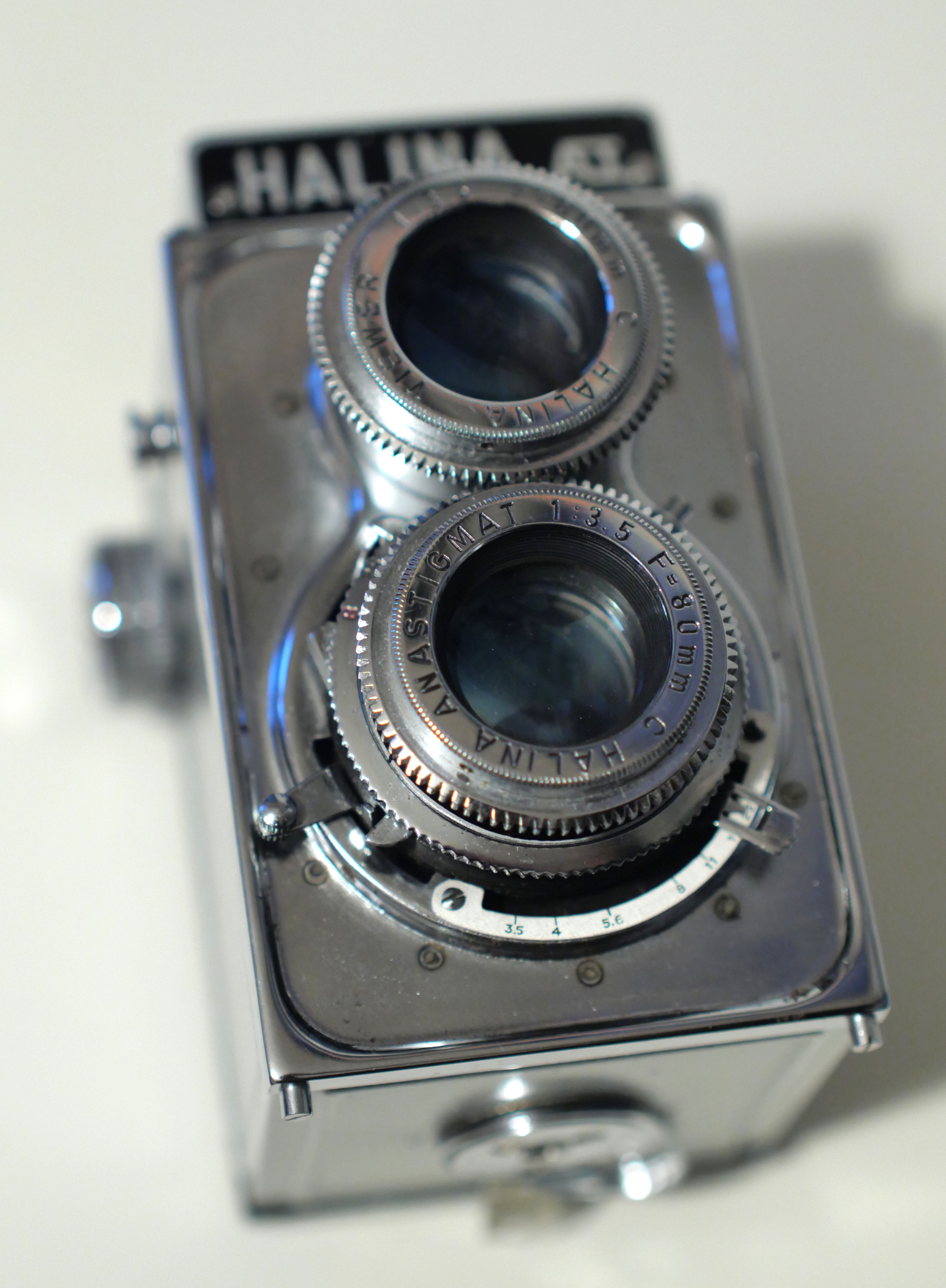
My photography is going vintage.  During lock down I have far more time than what I know what to do with.  Looking on eBay I saw a Halina A1 TLR camera for very little money and decided to bid on it.  I was the only bidder and won.  It was delivered promptly and as expected, the focus helicoids were frozen by the grease used in manufacturing.  The reflex mirror and ground glass were also quite dusty.  After watching repair videos on Ricohflex (Halina A1 is a direct copy of the Ricohflex) I was able to release the helicoids and lubricate with modern chain oil.  Also had to reset the focus the lenses.  After cleaning the reflex mirror and ground glass, the waist level finder is quite useable in daylight.  The leatherettes were failing apart.  I therefore decided to remove them all and painted the metal in silver.  Here is the camera after my mods and fully working


Camara: Halina A1
Lens: Halina Anastigmat 1:3.5 F=80mm C lens
Shutter speed: B, 1/25, 1/50 and 1/100s


I loaded with 135mm Kodak Colorplus 200 film for sprocket photography and also to test the camera works.  You really do not know if a film camera works until you run a roll of film through it.  I made sure to taped up the rear red window and the tripod socket mount to stop light leak.  These are the results.  They were shot on a sunny day during a walk in London.


In summary, I was able to get quite good results from this camera, I do have some reservations about it.  The camera is very light and the focus screen reasonably bright in day light.  The lack of shutter speeds is very limiting.  During the day, with the 1/100s max shutter speed, I had to stop down the lens to F16 or smaller all the time.  It will not be able to get shallow depth of field images.  This make the camera unsuitable for portraits.  Also the lack of slower shutter speed will restrict it use during low light situations.  During good light, you can get good results but very limiting.  It may now be used as a display camera at my home.  Although I do intend to shoot with it now and then.


Monday, March 22, 2021

Yashica 44 - First Impression


Recently I want to shoot film again.  I started photography shooting mostly with ranger finder cameras and then moving onto Canon SLR finishing with EOS 50E.  While looking through You Tube I came across a video of Yashica 44 converted to shoot 35mm film.  I was curious and found the camera quite cheap.  I purchased my camera at £50 on ebay fully working.  I did some cleaning of the camera lens, ground glass and reflex mirror.  The camera has a 60mm f3.5 lens with shutter speed of B, 1/25, 1/50, 1/100 and 1/300s.  Originally it uses 127 film which will results in 4x4cm square images.  12 images to a roll of film. Focusing was not as easy and I had to use the magnifying glass for critical focusing.  Framing was difficult as everything is opposite and took some getting used to.  

Converting to shoot 35mm film was very easy, by just unscrewing film roller which allow 35mm film to be loaded.  I won't go into too much details about the conversion, you can see how it is done here.

35mm loaded

Electrical tape covering the counter window

After a day of practising with the camera at home and taking it on walks, I was ready and went to London on an afternoon photo walk.  The film loaded was Fujicolor Superia Xtra 400.  It had expired long time ago but kept in my freezer so hoping it will be in good condition.

I took a walk in London with this camera with a light meter app on my phone.  Here are some photos I shot on the day.


I found the back to front view finder difficult to get used to.  The landscape shot above was very difficult as the view finder was back to front both vertically and horizontally.  Next time I will use the sport finder.  One thing I had to do was to unload the film in a changing bag at the end of the day.  This camera was not design for 35mm film and there is no way to rewind the film back in the cassette.  I had to do it by hand in the dark.  Overall, I am happy with the results and can't wait to get out with the camera again.  Maybe some portraits?