Monday, July 27, 2015

White on White

This is a series I started shooting at the end of 2014 and continue to shoot until recently.  Here are the highlights of the series so far and I would like to share with you all.

Model: Laura Lilly
MUA: Malika


Model: Jeniya Starkova
MUA: Silvia Tonelli


Model: Masha
Hair and makeup: Robyn Webb


Model: Jenny Miller


It is a series I intend to carry on with, once I have more ideas.


Thursday, July 16, 2015

Pentax 135mm f3.5 Super Takumar M42 Lens on Olympus O-MD E-M10

I reviewed this lens on Canon crop and full frame SLRs before and my conclusion was it is a very usable lens.  You can see how it performed on Canon DSLR bodies here.  It is an old M42 lens from the 70's which I purchased on eBay when I wanted a short telephoto lens on my crop body SLR.  It is a focal length I do not possess and reluctant to spend a lot of money on.  I am happy with it for occasional use.

The lens mounted on the camera

How does it perform on Micro Four Third camera?  It is easier to share the photos taken with this camera and lens combination.  All images here were shot with the Olympus O-MD E-M10.  Focus peaking was used for most of the shots, but quite a few were focus using the EVF without any focus aid.  On a M43 camera, the angle of view becomes 270mm on a full frame 35mm camera.  Quite a long lens.  With the IBIS of the E-M10  I did not find camera shake to be a problem in day light.  Even in darker places the IBIS was a significant help to produce blur free images.

Notice the length added by the adapter
Even longer with the hood

If you want to achieve shallow DoF, this lens is very capable.  The only issue I have is the working distance.  You will be a long way away from your subject.  For that type of work, I found the Olympus 45mm f1.8 to be just as capable.  For small objects, the minimum focus distance is longer than the Olympus 40-150mm f4-5.6.  I found the shorter focus distance meant I could get closer and achieved better background blur.

At f3.5 shallow DoF can be achieved

At f3.5 bokeh is quite smooth

You can shoot quite far from subject...

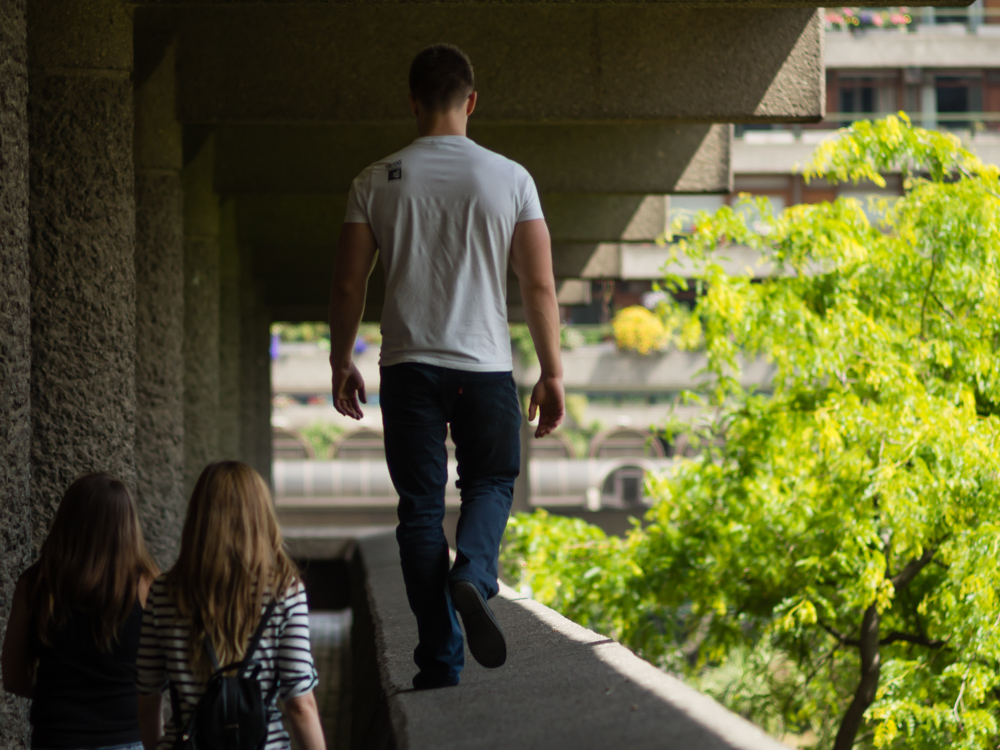
This was a quick grab shot.  It is a long way down if he falls...

Using the focal length to capture reflections on building

With 270mm angle of view, you can be quite a way from your subject.  I felt like spying which I was not entirely comfortable with.  I generally like to interact with my subjects.


Manual focus was reasonably easy once I got used to it.  This image of the cyclist below was shot without peaking as I did not have time to activate it.  Focus was spot on.  I only had time for a single frame before he was gone.

Manual focus of this cyclist was surprising accurate

Here are a few more shots using the 270mm angle of view to compress the depth.  Very useful to pick out selective element of a scene.


Image quality was again useful but it does not perform as well on a M43 sensor than a crop/full frame sensor.  If image sharpness is your primary goal, then this is not the lens for you.  Image quality was "OK".  There was often purple CA on the edge of high contrast areas.  The hood was essential, without it there can be significant lost of contrast in bright day.  Contrast is not up to modern standard and the colour rendering rather muted.  The nicely priced (but good) Olympus 40-150mm f4-5.6 lens will out perform it.  I found it to be a fun lens to use and like the experience.  Most people will be better served by the Olympus 40-150mm f4-5.6 lens,  It has silent auto focus, smaller, lighter and sharper.  I will reserve the Super Takumar 135mm f3.5 for the odd occasions when I need the combination of  focus length and faster f-stop.

Tuesday, June 16, 2015

Shooting Yashinon DX 50mm f1.7 M42 with Olympus OM-D E-M10

This lens was part of a large consignment of old photographic equipment I was given.  It belongs to the father of a coworker who no longer wants them.  As a Canon shooter I already has the Canon 50mm f1.8 so never shot with it.  However, I recently purchased a new Olympus OMD EM10.  With it's focus peaking and 3-axis in body stablisation it is the ideal camera to test it out.  With the lens fitted with an adapter here are some images from an afternoon shooting on the street of London.

Yashinon DX 50mm f1.7 mounted to Olympus OMD EM10

It is possible to get some good bokeh from this lens shooting wide open.  The EVF on the EM10  manual focusing was easy even without peaking.  The main draw back was in fact my camera.  Even  with ISO set to 100, on a bright sunny day, I had to stop down to f2.8 to avoid over exposure.


Of course I have no real reason to shoot with this lens at all.  I own the Olympus 45mm f1.8, a small light weight sharp lens.  How ever, I just like the feel of the Yashinon lens.  The focus ring was smooth, well damped and a joy to use.  Here are a few photos shot with this lens.


After checking the photos closely, I can say it is not as sharp as the Olympus 45mm f1.8.  The Yashinon lens is a fun lens to use and manual focus was a lot easier to use using peaking function.  The focus ring was very smooth and lovely to use and good quality photos can be achieved.  If you can get one at a good price then go for it but it is not up to the level of the native MFT portrait lens.  If auto focus is not important to you, adapted lens can be used to supplement native lenses.

Sunday, June 7, 2015

Pentax Super Takumar 135mm f3.5 M42 Lens In Depth Review

This lens can be had for very little money on eBay.  That was where I picked up this lens complete with original screw on hood.  Using a M42 to EOS adapter, I tested this lens on a Canon EOS 6D and EOS 650D.  On the 650D, the angle of view is similar to 216mm.  A 216mm f3.5 lens sounds attractive.


First of all, lets’ talk about the lens itself.  It has an aperture ring and is manual focus only.  It is all metal construction and is well built.  The focus ring is smooth with plenty of rotation required between infinity and minimum focus distance.  The long focus movement is a useful feature to aid focus accuracy.  I did not find it difficult to focusing in good light if the subject is not moving.  If the subject is moving, that is totally different experience.  This lens has an Auto or Manual switch near the base.  This refers to the aperture control.  In Auto, the pin at the back of the lens is pressed and the aperture ring stops down.  When using an adapter, it can only be used in Manual mode when you manually change the aperture.  It does mean the view finder gets darker if you stop down.  So, how does this lens do on a modern digital SLR?  Quite well is my answer.  For the cost it is amazing if you’re happy to focus manually.  You can achieve quite blur background with this lens.  Here are a few photos taken with my EOS 650D at f3.5.  The bokeh blur is quite respectable and a lot better than any kit lens can.  Here are a few photos taken with the lens wide open at f3.5.


f3.5 with Canon EOS 650D

f3.5 with Canon EOS 650D

f3.5 with Canon EOS 650D


This lens is reasonable good in resisting flare.  I shot the image below at f3.5 into the tree with the sun on the corner.  It does not do too badly.  On the same image, you can also see the level of chromatic aberration.  It is an extremely high contrast situation and it shows.  This is likely to be as bad as it can be.  You will need to shoot raw and post process if you want to avoid this.

Flare resistance not too bad

Not too much chromatic aberration for a high contrast situation 

One thing I’ve noticed is when stopped down, the camera over expose the same scene.  Here is an example of what I mean.  The following three images were taken at f3.5, f5.6 and f8.  The metering mode was centre weighted.  The scene is over exposed progressively worse from f3.5 to f8.  I did not try different metering mode, but it may be important to you if you shoot jpeg and will need to dial in exposure compensation if you stop down.  For me, it will not be a big deal as I will most likely to shoot wide open with this lens all the time.

f3.5 Canon EOS 650D

f5.6 Canon EOS 650D

f8 Canon EOS 650D


As a portrait lens it does quite well.  The following photo were taken with Canon EOS 6D, a full frame camera.
f3.5 with Canon EOS 6D

f3.5 with Canon EOS 6D

f3.5 with Canon EOS 6D

Here are a few more photos taken on a bright sunny day in The City of London.  All taken with Canon EOS 6D.  I shot as much as possible at f3.5 unless it was too bright, but I need not keep records of what aperture I shot at.


In summary it is a good lens.  It surpassed my expectation, if you don't mind manual focus.  135mm on a full frame camera is a great focal length for portraits.  There is very little distortion and shallow depth of field can be achieved with smooth bokeh.  Sharpness will not be up to the standard of modern lens but in a lot of cases, composition and content are more important than sharpness.  Sharpness on its own can be over rated.